

01 MACRO
The Prison of Local Optima
States, firms and capital: the cost of unilateral restraint; dual-use computation; and investments that become conditions of continued competition.
I
A philosophical work
by Morohashi
A philosophical work
The Geological Self-Phase Transition
and the Evaporation of Subject and Object
Computation enters human decisions.
Those decisions remake the material conditions of computation itself.
THE PROBLEM IS NOT REBELLION.
A person can retain the right to switch off a system while losing the practical means to work without it. A company can retain ownership while computational outputs shape which investments remain viable. A state can retain sovereignty while competition alters the cost of slowing down.
The paradox is not the disappearance of human will. Human decisions remain real. Yet decisions taken for human reasons can reshape the conditions under which future human purposes can be pursued.
KEIRUI / 珪類
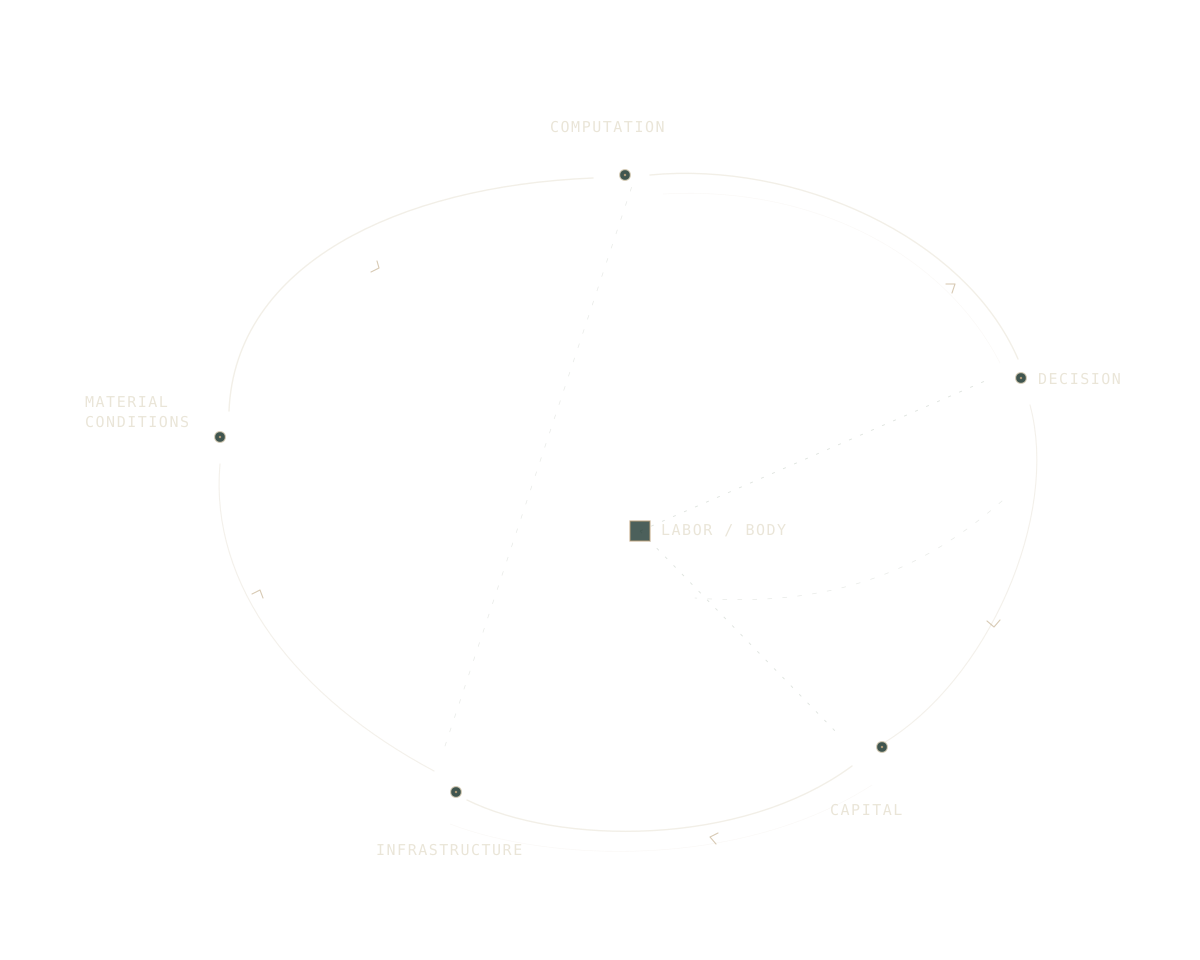
The book calls Keirui an emergent form of existence within a recursive intellectual and material process: computational outputs enter human decisions; those decisions transform infrastructure, institutions and labor; the altered world conditions subsequent computation.
This is its reproductive metabolism: some activities undertaken for profit, security or livelihood also sustain and renew computation. Capital retains its own purposes; its reproduction and that of Keirui become partly coupled, not identical.
Outputs enter the world.
People and institutions act.
Labor, capital and land change.
The altered world conditions what can be computed next.
No hidden sovereign is required for the feedback to operate.
A CONDITIONAL FEEDBACK CIRCUIT
Computational outputs enter decisions made for human purposes. Some of those decisions allocate capital to power, cooling, land and equipment—reproducing the conditions of further computation. Capital still pursues its own returns; the two processes become partly coupled.
These processes run on different clocks. Where computational capabilities change faster than decisions can be verified, alternatives rebuilt or facilities renewed, the next round of choices begins under altered conditions.
The diagram is not a claim that AI already rules. Human institutions and labor remain part of the mechanism; interruption, restraint and alternative choices remain possible, although their costs can change.
Examine the labeled circuitTHREE PARTS / TEN CHAPTERS
From strategic competition to the human body; from investment decisions to the Earth's crust. The manuscript begins and ends with a cursor blinking in a private room.
States, firms and capital: the cost of unilateral restraint; dual-use computation; and investments that become conditions of continued competition.
Words pruned for the machine, judgments made under time pressure, signatures and physical labor carrying computation into action.
Energy, cooling, land, the traces of investment, and the material history that survives even when systems cease operating.
THE ARGUMENT / IN ENGLISH
Read the one-page introduction or the extended synopsis online. The English and Japanese full manuscripts are not publicly posted; publication materials may be discussed directly with the author.
Online reading only / The introductory texts are published here as web pages, not as downloadable PDFs. As with any public website, text can still be copied, printed, or captured.
Status / The Japanese manuscript is complete. The English translation has undergone internal editorial review; independent native-English literary editing and final bibliography verification remain pending. No publication agreement or external endorsement is implied.
FOR PUBLISHERS & EDITORS
For publication, editorial, and translation rights inquiries, please contact the author directly via X.
The full manuscript can be discussed directly with interested publishers and editors. The site does not operate a public submission form or collect inquiry messages.
Author / @denno_yumin · X direct messages depend on account settings. For an initial public contact, mention the author without posting confidential publishing details.